Announcement

Collapse
No announcement yet.

1920 Harley Model F

Collapse
X
 
  • Filter
  • Time
  • Show
Clear All
new posts

  • TechNoir
    replied
    Hello folks, well its time for me to post a small update on my 20F and hopeful more updates to come in the near future.

    If you remember I found that the bores were in bad condition. The first port of call was to find someone who could be reliably trusted to bore out these blind cylinders. I spoke to Steve Slocombe who kindly put me in touch with the guy that he uses, the only downside was that he was 250 miles away.

    I also spoke to someone more local who came recommended so I went to him.

    The first thing he noticed was that my cylinders had been relined previously. This must have been done some time prior to 1936 which is the last time the bike was on the road. I left the cylinders with him and to cut a long story short it turned out that the existing liners have cleaned up nicely. As well as the scores and pitting the bores were also oval. No wonder it ran like a smoke machine. I have been told though that the previous lining job was actually very good. There are still some marks at the very bottom of the bores but they are below the rings so it is not a concern.

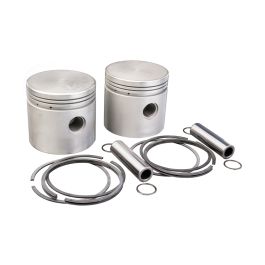
    After a debate and lots of thought about new pistons, I decided to go with new cast iron pistons so I spoke to another specialist also reasonably local to me who could cast them for me. I picked the pistons up just before Christmas. Here is a picture of the new piston castings, one old piston and the core box and pattern.


    Here is a close up of one old piston next to a new casting. Somewhere inside the one of the left is something that looks like the one on the right.


    I would have quite liked to have machined the pistons myself but 2 things put me off. One, I would have been really annoyed if I had made a mistake. Two, my milling machine isn’t functional at the moment so I don’t actually have the equipment available to do them. Therefore I got someone to machine them for me. I have used a more modern style plain cast iron rings which have been kept high to make sure that they avoid any of the remaining few marks at the bottom of the bore.

    I picked the pistons and cylinders up this morning (14th April 17)


    Once I knew that the pistons were done I knew that the next job was balance hence my post over in the Engine section.


    I deliberately hadn’t pulled the bottom end apart until the pistons were done so that the disassembly will still be reasonably fresh in my mind when I go to re-assemble it. One evening this week I reduced it from one lump into lots of bits.


    That brings things up to date. Whilst that is happening I need to find someone to machine the cylinders to accept new exhaust valve guides because the new valves are at best a rattle fit in the old integral guides.

    I do have a couple of other jobs to do which I had delayed until I had the engine work in hand so hopefully everything will come together in time to get some miles on the bike in the not too distant future.

    Watch this space.

    John
    Last edited by ihrescue; 03-18-2018, 12:52 PM. Reason: This post was edited to correct some bad photo links

    Leave a comment:


  • TechNoir
    replied
    Re: 1920 "F" Project

    Originally posted by T. Cotten View Post
    John!

    If the piston assemblies can be matched, what is the sense in splitting the cases?
    (Unless you fear the crank is a mess, too...)

    Just trying to help,

    ....Cotten
    Doh! Its obvious now that you say it. Thanks for the help

    John

    Leave a comment:


  • T. Cotten
    replied
    John!

    If the piston assemblies can be matched, what is the sense in splitting the cases?
    (Unless you fear the crank is a mess, too...)

    Just trying to help,

    ....Cotten

    Leave a comment:


  • TechNoir
    replied
    Re: 1920 "F" Project

    Eric, thanks for the link. That is interesting reading, I need to read it a couple more times and digest it but like you say it is good information.

    Cotten, thanks for the information and link, again good information that I need to read and digest. One question though, why do I need to weight the piston assemblies before splitting the cases? Why would it not be OK to weigh them after splitting the cases?

    John

    Leave a comment:


  • T. Cotten
    replied
    John!

    You won't know for certain until you measure it.

    Please also be aware that you probably would not find a factor worshipped by modern cradle-frame enthusiasts, as you have a single down tube design.
    The frame design figures heavily in factor choice: http://virtualindian.org/Flywheeltheory3.htm
    My best guess is that you would find it in the lower forties, similar to VLs.

    Balancing doesn't always mean carving on the flywheels.
    You may be able to make up the difference in pistons with thick-walled wrist pins, or "slugging" them. Please weigh all piston assemblies before splitting the cases!

    ....Cotten

    Leave a comment:


  • exeric
    replied
    There is some very good information here.

    http://www.antiquemotorcycle.org/bbo...gine-balancing

    Leave a comment:


  • TechNoir
    replied
    Thanks Cotten. I guess that the crank will need rebalancing so that will be something else to do.

    John

    Leave a comment:


  • T. Cotten
    replied
    Originally posted by TechNoir View Post
    I am off next week to see a guy about a re-bore. Obviously a re-bore means new pistons and new pistons will be aluminium as opposed to the originals that are cast iron.

    So my question is what is the recommendation regarding balancing the crank assembly when changing from cast iron to aluminium pistons?

    Thanks,

    John
    John!

    I would first attempt to back-calculate your original balance factor.
    Just put the assembly on knife-edges, and then add weight to the rod tops until it comes to balance.
    Then after weighing the piston assemblies and rod tops, the math is easy:

    Piston assemblies plus rod tops equals your total reciprocating weight.
    Added weight to achieve balance, plus rod tops is your 'trial' weight.
    'Trial' weight divided by the total weight gives the existing factor.

    Then, when you know the weight of the fresh piston assemblies, you can decide the best way to add or remove weight to achieve the same factor.

    ....Cotten
    Attached Files
    Last edited by T. Cotten; 10-23-2016, 11:24 AM.

    Leave a comment:


  • TechNoir
    replied
    Re: 1920 "F" Project

    I am off next week to see a guy about a re-bore. Obviously a re-bore means new pistons and new pistons will be aluminium as opposed to the originals that are cast iron.

    So my question is what is the recommendation regarding balancing the crank assembly when changing from cast iron to aluminium pistons?

    Thanks,

    John

    Leave a comment:


  • TechNoir
    replied
    Originally posted by wowswitch View Post
    Hi John,
    here is a page from my book... the plates are for a sidecar motor, just take them out. as for piston i was told to use HD VL pistons, they work and much cheaper, i got mine from
    https://aaok.com/index.php/motor-fla...-oversize.html
    good luck Ken
    Thanks Ken. My bike had a sidecar originally so it fits with the compression plates.

    My engine is a "J" so its 61 cu in so the VL pistons are too big unfortunately. I have had a few suggestions on what pistons to get for a J though.

    John

    Leave a comment:


  • wowswitch
    replied
    Hi John,
    here is a page from my book... the plates are for a sidecar motor, just take them out. as for piston i was told to use HD VL pistons, they work and much cheaper, i got mine from
    https://aaok.com/index.php/motor-fla...-oversize.html
    sidecar.jpg
    good luck Ken

    Leave a comment:


  • TechNoir
    replied
    Re: 1920 "F" Project

    OK, I now know why its been so oily.

    Currently the bike looks like this:


    And the engine was here:


    Before I took the jug off I took a picture of this. Is this correct? There are spacers under the cylinder and the nuts dont go all the way onto the studs.


    I had hoped that the rings were stuck, unfortunately that was not the case, here is the reason that that it burns oil.


    Ther corrosion is old and so are the score marks. If the engine has been kept in a house as a display item then it was like this when it was assembled in 1989 and was a result of decades of being in a leaking shed.

    Looking back at the build report (post #67) there is no mention of a re-bore or even honing them but it does say new rings.

    I assume that these can be re-bored?

    I guess my first port of call will be Steve Slocombe as he is here in the UK.

    Any ideas as the the best place to get oversize pistons?

    John

    Leave a comment:


  • TechNoir
    replied
    Re: 1920 "F" Project

    Back to basics has improved things.

    The timing was out due to 2 factors 1, I had forgotten that the mag pinion was keyed to the shaft so it was impossible to get the timing right with the key. I had left it where it was when I checked it many months ago before the motor went in the frame. I have removed the key and timed it 3/8 Inch BTDC (which is also 32 degrees BTDC) at full advance.

    Secondly I am not sure if the advance/retard mechanism has been returning the mag back to fully advanced when I turned the grip. I have made some adjustments but I am still not 100% happy. I think it will be one of those jobs that seems minor but will take ages to get right. One for a winter evening I think, until then it is easy enough to push the rod connected to the bell crank down by hand to make sure it is fully advanced.

    Also I have honed the carb needle and it has made a noticeable difference to the throttle action. The bike responds much more smoothly than before.

    I took it for a ride around the block to warm up and have been trying to make some adjustments. I still have 2 issues. First I cant get it to idle at a closed throttle. It will idle reasonably OK at a slightly open throttle but if I close it it stalls. I started with the slow running air screw at 3 turns out as per the manual and opening to 6 turns has only made a slight impact and it still stalls. I have adjusted both the air screw and throttle cam screw but still cant get it to idle. I will persevere but I need to sort out the second issue first

    This other issue is that it is burning a lot of oil and also spitting out a lot of unburned oil. I am using 50 weight non detergent oil that is correct for these old engines. There is oil in the exhaust and the plugs are fouling and there is loads oil smoke.

    I have been told on here 5 ounces (US ounces) of oil is required. By trial an error I have established that 4 pumps = 5 ounces. However the HD manual says 2 pumps is what is required (page 37 at the end of the instructions for flushing the motor with kerosene).

    If that is the case then am I putting double the amount needed in?

    I have read on here that two and a half pump fulls is needed and I have also read on here that 3 is needed. I am looking for advice because I have just drained the motor and have drained exactly 5 ounces. If 5 ounces is 100% correct then I guess I will need to pull the jugs but I dont want to if I don’t need to because I am putting double the amount needed in.

    Thanks,

    John
    Last edited by TechNoir; 10-09-2016, 09:46 AM. Reason: Typo

    Leave a comment:


  • ihrescue
    replied
    Hi Steve - FYI I sent you a PM with a question about carbs. Thanks

    Mike Love
    AMCA 19097

    Leave a comment:


  • TechNoir
    replied
    Re: 1920 "F" Project

    Originally posted by Steve Swan View Post
    I don't have the btdc settings at my immediate disposal, but they can be readily found under "Files" at jd yahoo groups. Once you are in "Files," you will see "Timing."
    Thanks Steve, I have asked to join the group so once they have accepted me I will be able to see the files.

    John

    Leave a comment:

Working...
X