Tank Caps

Collapse
X
 
  • Time
  • Show
Clear All
new posts
  • MikeW
    Senior Member
    • Apr 2015
    • 149

    #1

    Tank Caps

    Can someone remind me of the years that tank caps stamped "GAS" and "OIL" were used before plain caps became standard? I seem to recall that they were fitted up until 1925 and would therefore be correct for my 21F.
    P1050104.JPG
    Attached Files
  • exeric
    Senior Member
    • Sep 2005
    • 5962

    #2
    This illustration is from a 1920 H-D brochure. My '16 has plain caps so I guess this was a new feature in 1920.

    Brochure%2003c.jpg
    Eric Smith
    AMCA #886

    Comment

    • MikeW
      Senior Member
      • Apr 2015
      • 149

      #3
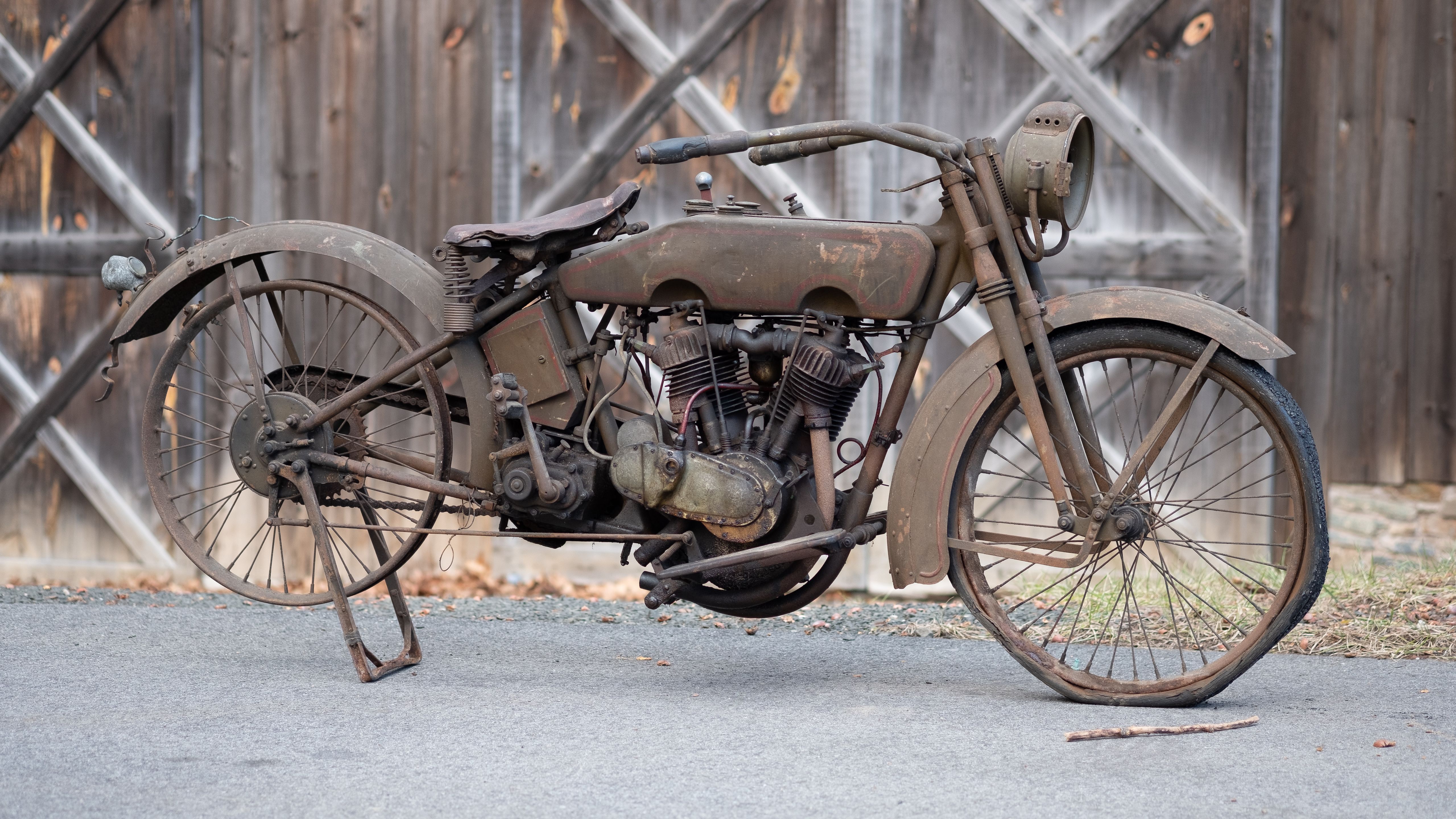
      Thank you Eric. Always something of interest and instructive from you. I had assumed (with no solid evidence or research of my own), that with the change in 1916 to the larger caps for gas and oil compartments, the practice of stamping "Gas" and Oil" (as on the smaller 1915 caps) simply continued until 1925 when "Gas" and "Oil" were then stamped on the gear shifter gate, and the caps themselves were unmarked. Your post sent me hunting in my files for any photos of (supposedly) original condition 1916 motorcycles. I found a few, but the only one which showed the tank caps was this one, auctioned by Bonhams some time ago. It has stamped gas and oil caps,(or at least a gas cap, is supposedly unmolested, but who can tell if someone changed the tank caps in the early 1920s?!

      Mike

      HD 1916 Bonhams 5.jpg

      HD 1916 Bonhams 2.jpg
      Attached Files

      Comment

      • exeric
        Senior Member
        • Sep 2005
        • 5962

        #4
        That is great information, Mike. The 1913-'21 parts book has no detailed description of caps for 16-'21 which is no surprise. The book simply states "EK29A: Gas cap (2): 1916-1921" and nothing about a marked gas, and oil cap. However the second picture you posted sure looks like the real deal. So now I'll be in the hunt for marked gas, and oil caps. I guess that's what keeps this hobby interesting, and never ending Thanks for posting those pictures.
        Eric Smith
        AMCA #886

        Comment

        • MikeW
          Senior Member
          • Apr 2015
          • 149

          #5
          You're welcome Eric. You've helped me a lot over the last few years. In case you are interested, there are a dozen or more high definition photos of the same 1916 motorcycle, two of which I posted (the one of the tank caps enlarged) , at

          • A wonderfully unrestored example • Featured on the programme 'Chasing Classic Cars' Boyhood friends William S Harley and Arthur Davidson began experimenting with powered transport in the early 1900s, producing their first complete motorcycle in 1903. Little more than a motorized bicycle, the prototype Harley-Davidson proved fragile, prompting a major redesign and the establishment of a reputation for ruggedness that endures to this day. Like many of their contemporaries, Harley-Davidson laid out their first engine along De Dion lines. A single-cylinder four-stroke displacing 25ci (400cc), the latter remained in production essentially unchanged until superseded by a 35ci cubic-inch (575cc) version in 1909. Of greater significance though, was the appearance that same year of the firm's first v-twin. Dropped at the year's end, the twin returned for 1911 in redesigned form boasting mechanically operated inlet valves (replacing the 'atmospheric' type inherited from the single) and production really took off. Known by the sobriquet 'pocket valve', this inlet-over-exhaust engine - built in 61ci (989cc) and 74ci (1213cc) capacities - would remain in production for the next 20 years. The Harley single's transmission arrangements – leather belt direct drive - were continued at first on the twin, but the need to make better use of the engine's power characteristics, particularly for sidecar pulling, prompted the introduction of a two-speed rear hub for 1914, mandating chain drive and a proper clutch be adopted. Later that same year a conventional, three-speed, sliding-gear transmission with 'step starter' was introduced on the top-of-the-range twin, with full electrical equipment, listed from then on as the Model J. Two important developments in the twin's evolution occurred in 1916: the most immediately obvious being the adoption of a gently curved fuel tank replacing the slab-side. Inside the engine, the cams were altered from two-lobe to four-lobe, making alterations to valve timing - previously achieved by reshaping the followers - that much simpler. The Harley-Davidson twin in this general outline would endure for the next eight years. A true survivor that has sat untouched for many decades. A superb discovery this Harley Davidson is a time capsule machine even rolling on a period tire. Parked many years ago and never tinkered with this fine machine sat in indoor storage and has only just recently seen the light of day when it was discovered by Wayne Carini. Featured on an episode of Chasing Classic Cars this Harley has not been touched in that time and is offered straight from the barn. To find such a significant Harley in this sort of condition is so rare and that it remained hidden away for so long is remarkable and survives in a fine state of preservation. A wonderful machine and a great discovery. A superbly preserved important Harley model and one that one who's discovery has been immortalized on television. For any serious collector interested in originality this one surely ticks all the boxes.


          All the best

          Mike.

          Comment

          • duffeycycles
            Senior Member
            • Apr 2010
            • 2009

            #6
            I question how original that bike is. Engine has '15 - early '16 open pushrod springs. Later '16 dropped intake. Late '16-'19 cylinders without wrap around fins.. '17 or later gear cover . All speculation, I wasn't there when originally built but it looks like top end is later than bottom & gear cover is later.
            Last edited by duffeycycles; 06-25-2025, 07:12 AM.

            Comment

            • exeric
              Senior Member
              • Sep 2005
              • 5962

              #7
              I was looking at my H-D 1916 new model brochure and saw this picture. I don't know how many times I've looked at that brochure and never noticed the GAS & OIL caps. Again, thanks for bringing up this topic, Mike.

              gas caps 16.jpg
              Eric Smith
              AMCA #886

              Comment

              • exeric
                Senior Member
                • Sep 2005
                • 5962

                #8
                5 months later and every day I walk past the plain gas/oil caps on my 1916F and it bugs me. Did anyone ever reproduce the embossed caps?
                Eric Smith
                AMCA #886

                Comment

                • MikeW
                  Senior Member
                  • Apr 2015
                  • 149

                  #9
                  Hello Eric. My apologies for being the source of your daily angst My originals are pretty much dinged and dented as in the first picture I posted and I too have looked for reproductions. The only ones I have found are these from Geloman in Germany. However, they appear to be turned from solid rather than skinned as the originals, and the "Gas" and "Oil" look to me to be engraved rather than embossed. I recall that a friend who restored a 18F some years ago had plain gas caps engraved by a local engraver. They were OK but wouldn't pass an AMCA judge. Like you, I'd welcome any info on reproductions. Mike
                  tank.caps.jpg

                  Comment

                  • exeric
                    Senior Member
                    • Sep 2005
                    • 5962

                    #10
                    Thanks, Mike. You would have thought that embossed caps would have stayed with a gas tank, but history and fate seem to make them separate like a bad marriage. The hunt goes on. Thanks for the picture.
                    Eric Smith
                    AMCA #886

                    Comment

                    • exeric
                      Senior Member
                      • Sep 2005
                      • 5962

                      #11
                      I revisited this thread started by MikeW and it got the wishbone working on the "gotta' have it bone". A person with tons of spare time on their hands could spend a lot of time making faithful reproductions of those caps. As Mike said, engraving the characters doesn't look like the die formed characters on the covered caps as OEM. so, I think you would have to have CNC tool & dies made to form the impressed characters, and it looks like there is a very subtle crown on the cap. Of course, additional tooling would be needed to crimp the cover on the bung, and finished with a knurled edge. . . Geeze ! Well, that tells you why original parts are so desirable, and why original parts are so scarce.

                      Shameless request: It you have a one, or both caps I would be interested.
                      Eric Smith
                      AMCA #886

                      Comment

                      • Tommo
                        Senior Member
                        • Sep 2001
                        • 1318

                        #12
                        Exeric.
                        Have a look at these and see if they spin your wheels and yes they are available.
                        The ribbed on the right is not for sale but put there to make people aware of that style of cap that was used in 1923.
                        It seems that late 1922 and early 1924 models may have also used that style of cap
                        Tommo DSCF4781.JPG
                        Peter Thomson, a.k.a. Tommo
                        A.M.C.A. # 2777
                        Palmerston North, New Zealand.

                        Comment

                        • exeric
                          Senior Member
                          • Sep 2005
                          • 5962

                          #13
                          I sent you a P.M., Peter.
                          Eric Smith
                          AMCA #886

                          Comment

                          • Tommo
                            Senior Member
                            • Sep 2001
                            • 1318

                            #14
                            Eric I sent you an e-mail
                            Did you recieve it ?
                            Peter Thomson, a.k.a. Tommo
                            A.M.C.A. # 2777
                            Palmerston North, New Zealand.

                            Comment

                            • exeric
                              Senior Member
                              • Sep 2005
                              • 5962

                              #15
                              I haven't seen anything on the email address I sent you, or this P.M. service here. I wonder if I have something that is blocking it. I'm going to send you another P.M. with a different email address, Peter. So sorry for this and I appreciate your patience.
                              Eric Smith
                              AMCA #886

                              Comment

                              Working...