
The Chevy Vega was not Nikasil.
Not even plated!
It was a high silicon aluminum alloy in which the aluminum was etched back after boring to expose the very hard silicon.
McLaren Racing had similar V-8 castings made at a foundry I worked at in the late 1960's.
The main problem with the Vega was that the engine blocks were die cast and had problems with porosity and inclusions.
-
Howdy chaps,
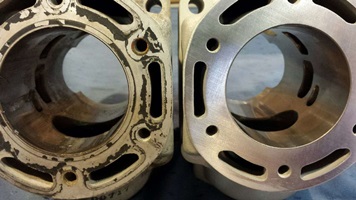
Mentioned this process prior. Unlike HD’s, especially flatties, Indian twins have low wall thickness at the base flange and are weakened by overboring and driving in an interference fit sleeve which serves to stress them more on a configuration with now compromised heat rejection characteristics. The process developed by US chrome in the 60’s and later refined at great expense by Mahle and trademarked as Nikasil when applied properly is nearly bullet proof in the consumer’s hands unless they elect to run without an air cleaner. When discussions of its perceived shortcomings arose in the late 90’s, many assumed, hard chrome aside, any cylinder plating treatment was Nikasil, which definitely was/is not. Even if actual Nikasil application quality varies from the horrible Chevy Vega to the Mercedes V8’s to the best, the air cooled Porsche RS and turbo series among others. Nikasil was developed for aluminum bores, not iron which as a host material is “dirty” and therefore requires a different process. Along with US chrome Millineum offers NSC plating at the link below.
Leave a comment:
-
Hi gquist,
I have a set of 101 Scout cylinders with the same heavy grooves from loose pins. If you don't mind my asking, what was the cost of the Nikasil plating on your cylinders?
dkgozLeave a comment:
-
I am going through the same issues with my 39 Scout, cylinders are rare to find, I sent mine to Vahan Dinihanian to be Nicasil Plated, it was .050 over and had a huge groove from a loose wrist pin in it, he is able to build them up to about .010 over but he requires that you do both so the friction characteristics remains equal between both cylinders. They won't wear anymore after coated, it is similar to what they use on a new car cylinder. He is on Facebook and has some of his work shown on there if you want to see it.Leave a comment:
-
Here's more about the Made-in-India cylinders, Sam!
Its from https://groups.yahoo.com/neo/groups/...tions/messages by Ed Glasgow (with thanks to Jim Seidell), dated Oct 2009:
"With the continued interest in new cylinders here is the list items that
must be looked at before installing any new India cylinders:
Here are some modifications may be necessary the India cylinders to fit
properly. There may also be others needed.
1. The top two fins on the front cylinder need to be cut between the
intake manifold so the nuts will turn.
2. The rear cylinder fins above the shifter tower. Hits the trans tower.
3. Grind clearance for both cylinders in the area where the carb.bowl is.
4. Valve guides are to large for the valve covers. Remove guides and turn
down to fit the valve covers.
5. Grind exhaust port area so the valve covers will fit. Do this when the
valve guides are out.
6. Intake nipples are too large for the nuts. Can usually be fitted with
valve grinding compound. Be easy doing this so you will not bind and shear
the pin on the nipple. Some cylinders come with new manifold nuts.
7. Head bolt holes may not be correct positions and head bolts will bind
on the holes in the head. Drill out cylinder head holes to next size.
8. Check head bolt thread depth in the cylinders. Some have bottomed out
and ruined a thread on the bolt and upon removal it took some threads out of
the cylinder. Use of 2" head bolts will help or shorten original head
bolts.
9. Hone cylinders to fit standard pistons as they are undersize ( a good
thing)"
Whew.
...Cotten
PS: Yahoo sux.Last edited by T. Cotten; 03-31-2018, 01:04 PM.Leave a comment:
-
Sam!Originally posted by samsmc1 View Post
I have no experience with Eastern cylinders.
There were extensive discussions on the VirtualIndian yahoo group about re-manufacturing the Eversure Auto Agency castings, which were probably the same, but I didn't pay attention.
Back to securing a sleeve,
I was schooled that the light press was essentially for heat transfer, as the enormous surface area is plenty of resistance to movement, even with a micro-fine finish. Cast iron doesn't shrink when over-heated like a tool steel, and the expansion coefficients of a cast iron sleeve in a cast iron cylinder are identical.
Perhaps Loctite offers a similar compound to Seal-Lock, but beware that their saccharin formulae may insulate instead of conduct, if they survive the heat.
Here's a sleeve that failed Folks...
(Sorry its upside-down; the burnt portion should be at the top.)
The reason it failed was the shoddy borejob in the casting. Although the sleeve never moved, there was not enough contact for heat transfer, with the voids insulating it further.
...CottenLeave a comment:
-
I used Seal-Lock Fluid Weld when replacing my knucklehead valve seats. Very good stuff. And Cotten's correct - very expensive.
Originally posted by T. Cotten View PostLeave a comment:
-
Cotten - you went past me on the locktite. We always set the interference at .0035 on modern engines with aluminum cylinder blocks without any locktite or pinning the new liner. I wouldn't even consider trying to pin the liners is an old Indian for fear of weakening the cylinder base after setting the interference at .0015., therefore it would seem that for saftey's sake, some locktite would be necessary. I fully understand the need for a fine finish on the sleeve and cylinder bore for heat transfer, but isn't securing the sleeve chemically just being cautious?
I have another question concerning Indian cylinders - I'm getting the pieces together to build stock appearing '51 chief. I have a set of cylinders that I purchased from Eastern 7 or 8 years ago. I didn't use them on the '48 that I'm restoring right now because they were crappy looking on one side where the fins aren't right. Other than appearance, have you ever heard of any problems with these cylinders? I want to bump up the power with better cams, carb, and ignition. I plan on using Carrillo type rods and new flywheels. I don't want this thing coming apart. Any advise on this?
Thanks
SamLeave a comment:
-
The real advantage of Seal-Lock Fluid-Weld, Folks,..
Is its chemical bond ("cross-links") with metals.
I first encountered it in the mid-'80s for pinning cracks in cast iron castings, but my bottle says "retains and cools valve seat inserts, valve guides & cylinder sleeves". (!)
"Nonflammable"; "Nontoxic"; "Withstands temperatures to 3000ºF"
"Seal-Lock International, Dresher PA 19025; Catalog number 30333"
T'aint cheap.
....CottenLeave a comment:
-
This same topic has been discussed recently on another forum that I am on. Someone has suggested that using something called Seallock International Fluid Weld as a medium for pressing and that it is a substance developed for use on the space shuttle and improves heat transfer between liner and cylinder.
I have no idea if this is correct and I have no experience of using it but I just thought I would throw it out there as I noticed Cottens comment that its mostly about heat transfer and I remembered a similar comment in the other forum.
JohnLeave a comment:
-
Its a lot, if not all about heat transfer, Folks!
I'm all with you Sam,.. up to the Loctite anyway.
There were a lot of vintage successes in spite of the modern failures.
So if your boremeister can produce a slick plateau finish (while stressed) within the casting, and a polish on the sleeve, then it should conduct and survive even better...
I'm all for undersized pistons if it keeps a Historical casting in service. (Balancing is a micro-issue.)
But I would still stress with a torque-plate the final hone-fit at very least.
(My Chief plates are magnesium printers' plate so I could lift it all. And that was then.)
The traditional "press" for any auto or motorcycle cylinder I have encountered was only ~.0015" (ignoring those forsaken two-strokes).
My schooling was that the length of the sleeve secured it naturally, while the press was to assure heat-transfer contact.
A lighter press interference would be helpful with an ancient crystallized casting, so indeed if there were such a goober that would improve heat transfer as well as add security, then it would come down to application technique.
'Silver-Seal Seal-Lock Fluid-Weld' does that on valve seats and guides; Sorry my two-decade-old link died somehow.
For all I know, Permatex has the same thing in a bottle. Maybe.
On to Peter's Nicosil suggestion,..
It was last decade (or two already), but apparently problems arose blamed upon high sulphur fuels and other things, as well as its a wallet-thinner.
Fuels are constantly changing. Wonder what the "Summer Blend" will be like this year Folks!
...Cotten
PS: The top plate only proved it futile for a flatty.Last edited by T. Cotten; 03-20-2018, 03:57 PM.Leave a comment:
-
Howdy sir,
I may be missing something here but don’t see anyone mentioning hard chroming back to stock (or any size you specify). Though unjustifiable for a 305 Honda a 35 Chief is a completely different proposition and I would never resleeve this rare piece ... or any other equally valuable old machine, that is old technology to be limited to very few situations in light of the superior structurall integrity, heat transfer, longevity and low RA this surface can be honed to.
Leave a comment:
-
I have a friend who is way ahead of me in the food chain when it comes to motorcycle machine work. After showing him the cylinders, he recommended and I think I will follow is advise that I take an automotive sleeve and machine it's OD to fit the existing bore after I square up the current cylinder bore and finish hone it. Then install a .100 smaller piston that I can have J&E make up for me. He suggested that I then install new seats before boring the sleeved cylinder to size and fit. He is adamant that the walls of the sleeve be at least .100 " thick to avoid them collapsing or causing hot spots. He is of the opinion that the seats can have shallow areas around them from where the original seats were dished out from previous grinding without damaging what little flow the original ports have to start with. We all agree that the cylinders need to be bolted to torque plates at least on the bottoms prior to honing.
Hairy - we always heat the cylinders up to 300 degrees and freeze the sleeves before installing them. Also in this situation, we'll set the interference at .0015 and use green Locktite so that we don't stress the thin original castings. No pins on anything this thin. I've never pressed a sleeve into a motorcycle cylinder.
Thanks
SamLeave a comment:


Leave a comment: